Understand and structure.
- Retrieval and source context
- Hypothesis extraction
- Strategy specification
- Code drafting
- Research memory and reporting
RAG × AI × Quant × Agent
A learning lab for understanding how research sources become structured hypotheses, reviewed code, historical backtests and reproducible diagnoses.
Trace the workflow →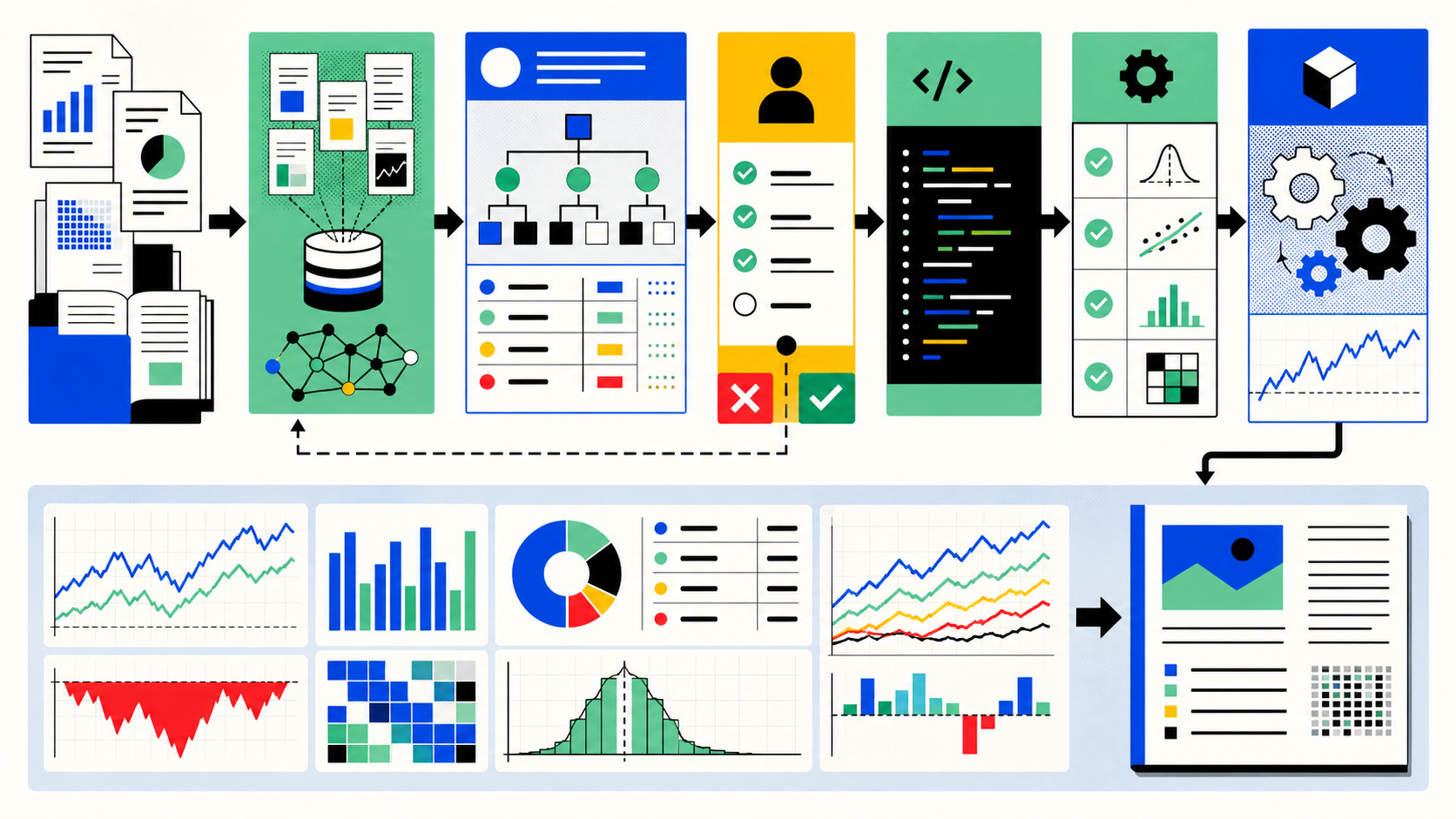
Specification before implementation
Read papers, reports, drafts, notes or bounded research inputs.
Convert rationale, indicators, signals, execution and risk into a typed StrategySpec.
Challenge economic logic, missing assumptions, ambiguity and data availability.
Create a code draft from the reviewed specification, not from an unconstrained prompt.
Check syntax, structure, indicators, timing, leakage and reproducibility risks.
Confirm specification fidelity, timing, costs and metric correctness.
Run a real historical engine and preserve configuration and artifacts.
Explain results, deviations, risk concentration and the next experiment.
Intelligence meets deterministic research
Does the Harness improve research?
Time, completion, first-run success, human edit rate, cost
Hypothesis completeness, citations, specification fidelity
Leakage, timing, indicator and metric error detection
Return, Sharpe, drawdown, turnover, costs and robustness
Learn upstream, own the interfaces
Source quality, retrieval and RAG evaluation.
State, tools, permissions, review and traces.
Point-in-time datasets and quality contracts.
Features, Alpha, backtest and evaluation.
Comparable protocols and release evidence.
Portfolio, risk and execution remain separately governed.
Typed specification, review questions and artifact lineage.
Parser, validation and diagnosis for A-share multifactor research.
Point-in-time universe, costs, neutralization and portfolio handoff.
Silent defaults, ungoverned fallback and direct execution authority.
First real research case
A 19-page sell-side factor report becomes a page-level evidence map, typed StrategySpec, tested order-reconstruction component and explicit replication-gap report.
Open Case 001 →Public disclosure boundary
This is an independent learning and integration project based on public upstream material. It does not claim affiliation, authorship, upstream contribution, live performance or production-trading capability.
Visit the official ALAGENT site ↗